Service Now
Introduction
I have started to build a large 600 share Service Now position this year up to my 4th biggest position behind Amd, Tlt, and Amzn. I have been monitoring this company for the last couple of years after seeing the ceo on multiple different interviews. I liked his confidence and ambition toward the company, I looked into the company and saw employee satisfaction was super high which is always a great thing to see, but the valuation multiples didn’t make sense. When the company started being depressed in late 2025 I took an interest, researching their recent acquisitions of of workflow intelligence and enterprise automation tools to see how they were expanding their moat. When the software sector faced massive AI panic starting in 2026, the market began pricing in a narrative that autonomous AI agents and automated coding tools would completely disrupt enterprise software and render workflow platforms obsolete. As the stock began falling hard, I initiated my position in the 150 to 160 range, continuously averaging down as fear pushed the price all the way into the mid 80s. I did not buy into the blanket narrative that AI disruption will destroy all software companies, especially since quality software plays a key role in my portfolio. In reality, ServiceNow is not going to be replaced by AI; it is uniquely positioned to be the central platform that manages and orchestrates AI agents across the enterprise. Its unmatched platform stickiness, workflow dominance across HR, IT, and customer service, and elite leadership mean that AI will ultimately serve as a massive growth catalyst rather than a threat. Seeing the market indiscriminately dump a world class business gave me the ultimate conviction to keep accumulating and build ServiceNow into a core 600 share holding.
Business Model
To understand why I am so convicted on ServiceNow, you have to understand the fundamental difference between a System of Record and a System of Action. For the last two decades, enterprise software was dominated by Systems of Record. Think of companies like Oracle, SAP, Salesforce, or Workday. These are essentially massive, complex databases. They are incredibly sticky and valuable, but their primary function is to store data and answer the question of what happened. ServiceNow was built on an entirely different philosophy. It is a System of Action. It does not just store the data; it reaches across the aisle to all of those different databases, reads the information, and actually orchestrates the work. It is the general contractor of the enterprise. Whether it is an IT incident, a complex HR onboarding process, or a customer service resolution, ServiceNow sequences, tracks, and automates the hundreds of invisible steps required to get the job done. This platform has become so critical to global infrastructure that approximately 85 percent of Fortune 500 companies currently run their operations on it. Once a massive corporation integrates ServiceNow as its central digital nervous system, tearing it out causes complete operational paralysis. That is exactly why their gross retention rate sits consistently at 98 percent. That 98 percent is not just a metric; it is the ultimate economic moat. It represents massive switching costs and a deeply entrenched network effect. When every single department from HR to IT to Legal relies on a singular platform to route their daily workflows, a competitor cannot just offer a cheaper alternative. The frictional cost of ripping out the operational brain of a Fortune 500 enterprise is simply too high, ensuring ServiceNow’s revenue compounding remains incredibly safe and predictable.
Agentic Ai Orchestrator
The prevailing bear case during the software panic assumed that because generative AI can write code and automate basic tasks, traditional software platforms would be rendered obsolete. This completely misunderstands how massive enterprises actually operate, and it misses the single biggest shift happening in corporate infrastructure right now: the transition from managing human workflows to managing a blended workforce of humans and autonomous agents. Historically, ServiceNow’s economic moat was built around governing the people. Moving into the future, their moat will cover the people and the explosive volume of AI agents. We are standing on the precipice of a massive structural shift in sheer adoption numbers. According to Gartner, 40 percent of enterprise applications will embed task-specific AI agents by the end of 2026, a massive leap from less than 5 percent at the start of 2025. Furthermore, recent data from S&P Global and McKinsey shows that 31 percent of enterprises are already running at least one AI agent in production today, with over 60 percent planning full deployments within the next two years. The volume of agents entering the workforce is staggering. Gartner predicts that by 2028, AI agents will actually outnumber human workers in commercial roles by a factor of 10 to 1. However, you cannot just unleash a 10-to-1 ratio of autonomous digital workers into a corporate environment and hope they do the right thing. Gartner explicitly warned that without the right data foundation, workflow integration, and governance, companies will suffer from chaotic “agent sprawl”. In fact, they predict over 40 percent of agentic AI projects will ultimately be canceled by 2027 simply because companies lack the infrastructure to control them. Having thousands of AI agents is entirely useless and a massive security liability if they operate in fragmented silos without strict oversight.
This is exactly why ServiceNow will be fully integrated into this new way of working, and why they will benefit massively as agent volume multiplies. With their recent Yokohama release and the introduction of the AI Agent Orchestrator and Control Tower, ServiceNow is the exact data foundation and workflow integration layer that experts say is required to prevent agent sprawl. They are not competing with the influx of AI agents; they are the central nervous system managing them. Instead of just routing human IT tickets, the Orchestrator acts as the enterprise command center, ensuring that every single one of those new AI agents operates securely, follows corporate policy, and communicates seamlessly across departments. As the number of AI agents inside Fortune 500 networks scales exponentially over the next decade, ServiceNow will capture immense value by serving as the indispensable control plane that turns chaotic agent sprawl into a governed enterprise utility.
The plan for the Future
Looking ahead, management’s vision is not just ambitious; it is backed by concrete timelines and a highly structured execution plan. CEO Bill McDermott has made it abundantly clear that he views Service Now as the defining enterprise software company of the twenty-first century. At their recent Financial Analyst Day, management laid out their roadmap, explicitly targeting over $30 billion in subscription revenue by 2030, a number McDermott casually referred to as his “bear case”. To put that in perspective, they just raised their 2026 revenue guidance to roughly $15.78 billion. They are effectively planning to double their core revenue base over the next four years while scaling to a “Rule of 60” profitability metric by 2030. The reason they are so confident in these massive growth targets is precisely why I started buying the stock: management completely rejects the narrative that AI is a disruption to their business model. During the “SaaSpocalypse” panic of early 2026, the market was terrified that autonomous agents would lead to massive headcount reductions, crushing per-seat software licenses. But McDermott recognized this shift early and positioned the company to be the “agentic front door to the enterprise”. They are actively decoupling their revenue from human headcount by transitioning to outcome-based pricing. Through their “Now Assist” platform, they are charging for the actual consumption and execution of AI workflows. They expect AI to represent over 30 percent of their Annual Contract Value by 2030, and with AI ACV already crossing the $1 billion mark in Q2 of this year, they are proving that AI is not cannibalizing their business it is their largest growth catalyst in history.
I fundamentally agree with this thesis. The future of corporate operations is going to be heavily reliant on autonomous agents. We are moving toward a reality where specialized digital workers will handle the bulk of enterprise labor, and every major company will deploy fleets of these agents to run their operations. However, those agents are entirely useless if they exist in isolated silos. They need a central hub to communicate, verify identity, and execute actions across HR, IT, and customer service without breaking compliance. ServiceNow is positioning itself as that exact orchestrator. By owning the control plane where all of these agents integrate, they capture the ultimate value in the AI chain, making the platform exponentially more essential with every new technological advancement. But there is a catch: an AI agent that can autonomously execute workflows across an entire Fortune 500 network is a massive security liability if it does not operate within strict governance and identity protocols. You cannot have autonomous bots pulling data and changing permissions without knowing exactly what they are touching. That critical vulnerability is where the cybersecurity side of the business comes in, bringing us directly to their massive recent acquisitions of Armis and Veza, which we will dive into after going over their earnings.
Q2 2026 earnings report
When you look at the Q2 2026 earnings report, you have to look past the headline numbers and actually dig into what the market was worried about. The stock had been severely pressured all year, trading at its lowest valuation multiple in history. The bears were loud, and they had a very clear, logical thesis: AI kills per seat pricing. The argument was simple. If an AI agent allows one human to do the work of three, enterprise companies are going to lay off workers and buy fewer software licenses. That “seat compression” narrative drove the entire software selloff, and it was a valid concern. But the Q2 report fundamentally changed the thesis because it proved that ServiceNow recognized the threat early and aggressively adapted their billing model. Management addressed this directly on the call: roughly 50 percent of all new business is now non seat based. They are actively shifting away from charging per human login and moving toward charging for actual platform consumption and automated outcomes. By bundling their new AI capabilities into the platform, they are actually seeing pricing uplifts of 20 to 30 percent. The fear was that seats would decline and revenue would crash; the reality is that the consumption model is replacing that legacy revenue at a higher premium.
To avoid being blindly bullish, we have to look at the real pressure points in the report. ServiceNow is investing heavily to build out this AI infrastructure, and it is impacting their profitability. Subscription gross margins slipped to 81 percent, which management admitted reflects the very real costs of accelerating AI adoption and paying for hyperscaler infrastructure. Developing and hosting enterprise grade AI is expensive, and it is lightly eating into their gross profitability. There was also a sharp, heavily scrutinized drop in free cash flow margin, which fell from 44 percent in Q1 down to just 16 percent in Q2. If you read that metric out of context, it looks terrifying. However, you have to understand the business cycle. ServiceNow’s cash collections are heavily and seasonally front loaded because a massive share of their annual contracts renew and get billed in the first quarter of the calendar year. They maintained their full year free cash flow margin guidance at a very healthy 35 percent. You also have to factor in Stock Based Compensation, which remains high at roughly 15 percent of revenue. That is a real cost to shareholders that dilutes equity and cannot be ignored when evaluating their true cash generation.
Despite the margin pressure and the SBC concerns, the top line execution is why the stock rebounded and why I aggressively bought the dip. Subscription revenue came in at 3.87 billion dollars, growing 24.5 percent year over year and beating the high end of their own guidance. The biggest metric that destroyed the bear case, however, was their AI Annual Contract Value. ServiceNow AI crossed the 1 billion dollar ACV mark a full quarter and a half ahead of their year end target, with net new AI ACV accelerating over 40 percent sequentially. They also closed 123 transactions worth over 1 million dollars in net new ACV, which is up nearly 40 percent year over year. When enterprise customers are writing seven figure checks at that velocity in a tight IT budget environment, it shows that the vendor consolidation thesis is real.
To truly understand the safety of this investment despite the AI disruption fears, you have to look at the balance sheet predictability. The most important metric for a SaaS company is cRPO, or Current Remaining Performance Obligations. This is the contracted backlog of revenue expected to be recognized over the next twelve months. In Q2, their cRPO reached 13.2 billion dollars, growing 21.5 percent in constant currency. Total Remaining Performance Obligations expanded to an astronomical 29 billion dollars. This means they have 29 billion dollars of legally binding, guaranteed future revenue sitting in the pipeline. That level of visibility completely insulates their forward earnings from short term macro shocks. When you combine mid 20s revenue growth with a 35 percent full year free cash flow margin, they are still operating well above the Rule of 50. The market panicked and sent the valuation down to roughly 21 times adjusted forward earnings, pricing in a worst case scenario that the underlying data proved completely false.
Recent acquisitions
To fully appreciate ServiceNow’s strategic vision, you have to look at their recent M&A activity. Over the last year and a half, management has executed an absolute masterclass in capital allocation, using their massive free cash flow to systematically buy up the critical infrastructure needed to secure the AI era. They are not just building a software platform; they are building a fortress.
Moveworks
First, they executed the acquisition of Moveworks, closing the deal in December 2025 for roughly 2.85 billion dollars, marking the largest acquisition in ServiceNow’s history. This was a massive, strategic leap directly into agentic AI. Moveworks built a state of the art front-end AI assistant and an enterprise search platform powered by an advanced reasoning engine. To understand how these two companies came together and why the integration works so flawlessly, you have to look at their history. Before the acquisition, Moveworks was already deeply intertwined with ServiceNow’s ecosystem. In fact, the majority of Moveworks’ customers were already using ServiceNow as their primary system of action to fulfill the requests generated by the AI assistant. From a technical standpoint, the two platforms were entirely compatible, meaning ServiceNow did not have to spend years rewriting code to make the acquisition functional. It was a plug-and-play powerhouse. Following the deal, ServiceNow rapidly integrated Moveworks’ technology to launch EmployeeWorks which is a conversational front door that seamlessly feeds into Otto, ServiceNow’s unified enterprise AI layer.
This integration solves the ultimate friction point in traditional corporate IT. Historically, when an employee needed something, whether that was requesting a new laptop, resetting secure access, or fixing a software bug, they had to navigate clunky portals or wait days for a human help desk to route the ticket. Moveworks fundamentally solves this by acting as the ultimate conversational front door. Employees simply type their request in natural language, and instead of just pointing them to a static knowledge article, the Moveworks engine understands the context, plans the required steps, and autonomously triggers the workflows within ServiceNow to actually execute the task. Within ServiceNow’s own internal operations, AI agents are already resolving 90 percent of IT requests and 89 percent of customer support requests autonomously, cutting resolution times nearly sevenfold. By fully integrating Moveworks into products like EmployeeWorks and their unified AI layer, Otto, ServiceNow is bringing this massive productivity unlock to all of their clients. This adds an incredibly deep layer to their economic moat. When you give an enterprise a single, unified AI interface that instantly solves problems across every department, you completely eliminate the need for fragmented, third-party IT or HR support chatbots. It drives massive vendor consolidation. The user experience becomes so seamless and entrenched in the daily routine of the enterprise that ripping it out becomes completely unthinkable.
The vision for the future here is absolute orchestration. Moveworks serves as the intelligent interface that hides all backend complexity, while ServiceNow acts as the central nervous system executing the actions. But an AI agent that can autonomously execute workflows across an entire Fortune 500 network is useless, and incredibly dangerous, if it does not operate within strict security and identity protocols. You cannot have autonomous bots pulling data and changing permissions without knowing exactly what they are touching. That vulnerability brings us directly to why their next two acquisitions were so critical to building the AI fortress.
Veza
Following the Moveworks deal, ServiceNow immediately moved to secure the massive vulnerability that autonomous software creates by announcing the acquisition of Veza in December 2025. Veza is a leader in AI-native identity security, built to solve one of the most complex challenges in modern enterprise infrastructure: knowing exactly who and what has access to critical data. Before the acquisition, Veza had already scaled to a massive footprint, managing over 30 billion access permissions worldwide for global enterprises like Blackstone, Expedia, and Wynn Resorts. To understand the story of how these two fit together, you have to look at how enterprise cybersecurity has fundamentally shifted. The reality of the modern cloud era is that attackers do not hack in anymore; they log in. Identity-based attacks now account for roughly 90 percent of all corporate breaches. When you combine that existing vulnerability with the incoming explosion of autonomous AI agents, the enterprise attack surface multiplies exponentially. As I mentioned in the orchestrator section, deploying thousands of non-human AI agents to execute workflows is incredibly dangerous if you do not know exactly what data or permissions they hold. Traditional, static access directories simply cannot keep up with machine-speed agents.
Veza solves this entirely through its proprietary “Access Graph,” which maps true effective permissions across cloud, SaaS, and on-premises systems. It translates incredibly complex entitlements into clear, real-time intelligence, instantly identifying overprivileged accounts or toxic permission combinations. The integration here is flawless because the two platforms solve complementary halves of the exact same problem. As Blackstone’s CTO perfectly articulated when the deal was announced, ServiceNow powers the horizontal business workflows, while Veza enforces “least privilege” and adds identity intelligence at scale. By directly embedding Veza into the ServiceNow AI Platform specifically feeding into their Security Operations, Integrated Risk Management, and the AI Control Tower ServiceNow is no longer just executing automated tasks. They are actively governing them. Now, when an AI agent or a human employee triggers a workflow, Veza instantly maps their “blast radius” and enforces strict access protocols before ServiceNow allows the action to execute.
This adds an impenetrable layer to ServiceNow’s economic moat. By tying identity risk directly into the workflows where remediation happens, they have effectively built an Enterprise Identity Control Plane. It gives them the trusted, native identity layer that AI agents absolutely need to act safely at scale. Moving forward, an enterprise cannot afford to buy a fragmented identity tool and patch it onto a separate workflow engine; they need a unified system that governs both natively. But securing digital identities and cloud workflows is only half the battle. In the modern industrial enterprise, digital workflows constantly interact with physical, unmanaged assets from factory floor sensors to hospital equipment and IoT devices. That massive gap between digital software and physical hardware brings us directly to their final, and most expensive, strategic acquisition: Armis.
Armis
To close the loop on this massive security overhaul, Service Now
finalized its 7.75 billion dollar acquisition of Armis in April of 2026. This was the largest purchase in their history, and it is the exact piece of the puzzle needed to bridge the gap between digital workflows and physical hardware. To understand why this acquisition is so transformative, you have to look at the massive blind spots in modern enterprise security. While Veza secures the digital identity layer and Moveworks handles the conversational interface, massive industrial enterprises have hundreds of thousands of completely unmanaged physical assets. We are talking about factory floor sensors, hospital medical equipment, industrial control systems, and basic connected devices. You cannot install traditional security software or agents on an MRI machine or an industrial robotic arm. Historically, these physical endpoints created a massive vulnerability because IT departments simply could not see them, let alone secure them.
Armis fundamentally solves this problem. It is an agentless cyber exposure platform that automatically discovers, classifies, and continuously monitors every single connected asset in an environment, regardless of what that device actually is. The integration story here is where the true value lies. Before the acquisition, Armis and Service Now were already tightly partnered, with Armis feeding its real time asset data directly into ServiceNow’s Configuration Management Database. But by bringing Armis natively into the ecosystem, ServiceNow has created an unprecedented closed loop system. Historically in cybersecurity, the tools that detect the risk cannot execute the remediation, and the tools that execute the remediation cannot see the full picture. That disconnect creates a dangerous lag time between a threat and a response. By directly wiring Armis into the Service Now AI Control Tower, that lag time effectively drops to zero. If Armis detects abnormal behavior on a physical device out on a manufacturing floor, it does not just send a passive alert to a security dashboard for a human to review. The native integration allows the system to autonomously trigger a workflow in ServiceNow to quarantine the device, revoke its access, and route an emergency ticket to the right team all at machine speed. This completes the absolute fortress around the Now platform. They have the conversational interface with Moveworks, the digital identity governance with Veza, and the physical asset intelligence with Armis. By controlling the entire lifecycle from threat detection to automated remediation across both digital and physical domains, Service Now has effectively tripled its total addressable market for security solutions. They are no longer just an IT workflow engine; they are the unified operational and security brain of the entire global enterprise, perfectly positioned to deploy agentic AI safely into the real world.
Valuation
When you look at the top tier names in the cybersecurity sector, the market commands massive premiums because security is the ultimate non discretionary spend. A company like Palo Alto Networks currently trades at a forward P/E approaching 96. CrowdStrike consistently trades at astronomical EV to sales multiples because their moats are so incredibly sticky. I am not arguing that ServiceNow should be valued strictly as a pure play cybersecurity company like Palo Alto or CrowdStrike. Security is only one piece of their massive puzzle. However, they absolutely deserve to trade at a structurally higher multiple than a standard enterprise software company. If you look at ServiceNow purely on a trailing twelve month basis, the TTM PE sits in the mid 70s. But the market is a forward looking mechanism, and that is where the true discount becomes obvious. When you factor in their massive revenue growth and margin expansion, their forward PE compresses down into the mid 20s. To put that in perspective, this is a company that historically traded at an average forward PE well over 60 during its primary growth phase. Their Enterprise Value to Sales multiple currently sits around 8 times forward estimates, which is a massive compression from their historical 15 times average. Furthermore, you have to look at their cash generation. They maintain a flawless 35 percent free cash flow margin, giving them a free cash flow yield of roughly 4 percent. When you combine their top line growth with their cash generation, their PEG ratio, which measures Price to Earnings Growth, sits right at 2.4. This is exactly in line with slower growing peers, proving that you are not overpaying for their premium.
To keep this completely objective, we have to compare that forward valuation against their legacy software peers. If you look at a company like Salesforce, it currently trades at a much cheaper valuation of roughly 27 times forward PE. But there is a massive reason for that gap. Salesforce has largely completed its operating leverage journey, and its top line revenue growth has slowed down to roughly 11 percent. Workday is another great company trading around 37 times forward earnings, but it is entirely siloed within HR departments. ServiceNow, on the other hand, is growing its consensus revenue at over 20 percent year over year. You are paying a premium over legacy peers, but you are buying significantly faster growth, elite unit economics, and a platform that integrates across every single department. In my opinion, ServiceNow is perfectly positioned to maintain a 20 percent revenue CAGR over the next five years. We will dive deeper into those exact financial projections and scenario modeling in the next section, but that compounding growth rate is exactly why this valuation makes total sense.
Finally, the real catalyst for the stock over the coming years is the structural valuation expansion that should happen as the market digests their new cybersecurity footprint. Wall Street still prices ServiceNow strictly as an IT workflow tool. But with the integrations of Armis and Veza, they have built an enterprise security and identity control plane. When you look at the top tier names in the cybersecurity sector, the market commands massive premiums because security is the ultimate non discretionary spend. As a proud shareholder of Palo Alto Networks, I know firsthand that best in class cyber leaders deserve astronomical multiples, with Palo Alto often trading near 96 times forward earnings. Palo Alto operates an absolutely elite, industry leading platform, and I am not arguing that ServiceNow is a better pure play security company. They serve different fundamental purposes. However, ServiceNow sits at a totally unique intersection. While pure cyber companies excel at threat detection and network defense, ServiceNow acts as the ultimate orchestration layer where that security intelligence meets workflow execution. Because they own the automation layer that actually fixes the vulnerabilities across human and AI agents, they absolutely deserve to trade at a structurally higher multiple than a standard enterprise software company. As Wall Street wakes up to this massive TAM expansion, we should see their multiple expand to reflect their newly built fortress.
Projection
To validate the multi-year return profile of this position, I ran a detailed financial model across Bull, Base, and Bear cases. The core underlying driver of this entire model is simple: AI and cybersecurity integration will not drag down growth; they will actively re-accelerate it. Wall Street initially priced in margin compression and integration friction, but as these capabilities scale, top-line acceleration will force a major multi-year re-rating of the stock.
The market currently discounts ServiceNow due to perceived integration risks following the multi-billion-dollar acquisition spree of Moveworks, Veza, and Armis. Skeptics argue that integrating three massive cybersecurity and AI architectures brings execution risk, cultural friction, and margin drag. However, this narrative completely ignores the operational reality. These acquired companies were not unfamiliar entities; they were long-standing partner platforms whose technology stacks were already deeply embedded in the ServiceNow ecosystem. ServiceNow is not stripping these assets apart; they are fully integrating their elite engineering and executive teams. By giving these top-tier teams the massive scale and global distribution power of the Fortune 500 sales force, ServiceNow enables them to continue innovating at hyper-speed within a unified platform. As consumption-based AI pricing, Now Assist add-ons, and integrated cyber capabilities take hold, net expansion rates will move higher. When the market sees revenue growth re-accelerate back toward the mid 20’s percent range, it will prove that these strategic investments were worth every penny. That top-line execution will trigger a classic multiple expansion, shifting the stock’s forward valuation from depressed lows back toward premium software and security multiples.
Using a baseline stock price of $119.49 and a share count of 1.047 billion shares, the numbers highlight an exceptional risk-adjusted asymmetric setup over a five-year horizon.
The bull case: I’m modeling revenue at a 22 percent compound annual growth rate (CAGR), pushing revenue from $16.31 billion in 2026 to $36.14 billion by 2030. This scenario reflects rapid enterprise adoption of autonomous agents and security workflows, crushing management’s baseline targets. Net income margins expand steadily by 100 basis points annually, moving from 19 percent in 2026 to 23 percent by 2030 as operational leverage and high-margin AI consumption scale. Net income reaches $8.16 billion ($7.79 EPS).Applying a 55x to 65x P/E multiple reflecting a fully re-rated, integrated enterprise AI control plane yields a 2030 share price between $429 and $506. This represents a 38 percent to 43 percent CAGR from current levels.

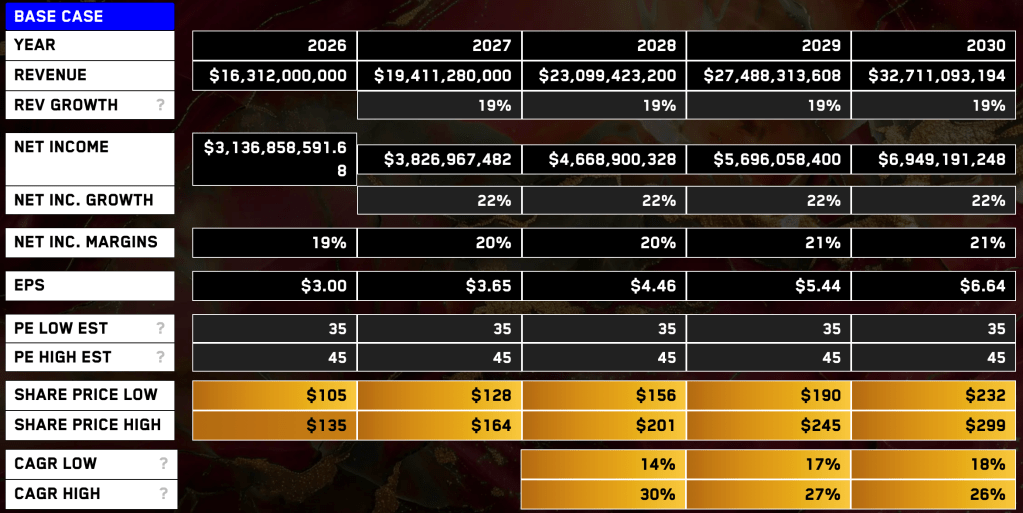
The base case: Models a conservative 19 percent revenue CAGR, bringing total top-line revenue to $32.71 billion by 2030. This aligns directly with management’s public guidance of exceeding $30 billion in subscription revenue. Net margins expand moderately from 19 percent to 21 percent as AI investments stabilize. Even under standard valuation metrics without an aggressive multiple re-rating, double-digit top-line growth combined with high cash conversion delivers a compounding return profile that significantly outperforms the broader market.
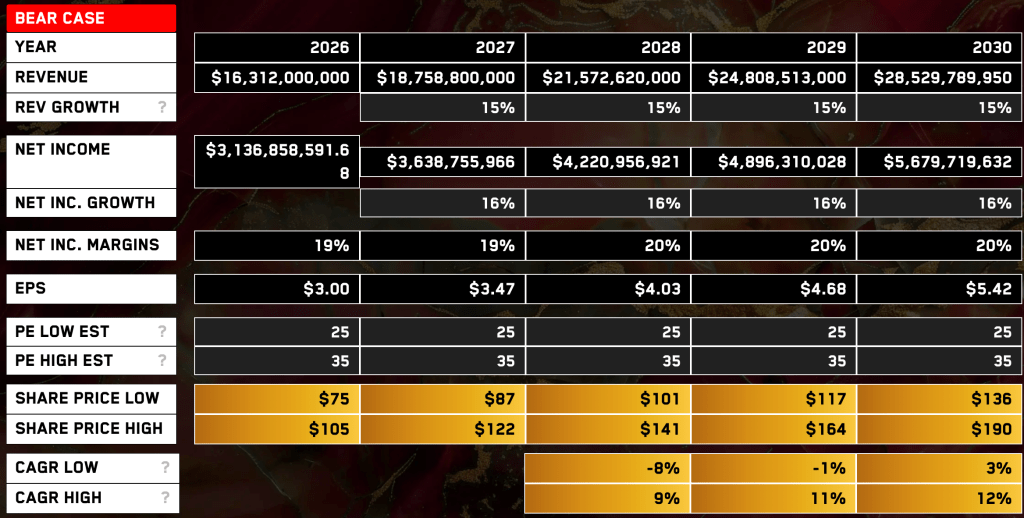
The bear case: Assumes revenue growth decelerates into the 14 to 15 percent range due to macro headwinds or slower enterprise AI rollout schedules. Margins remain capped near current levels around 18 to 19 percent due to ongoing infrastructure costs and stock-based compensation. Because ServiceNow maintains a 98 percent gross retention rate, $29 billion in contracted RPO backlog, and a 35 percent free cash flow margin, the downside is heavily protected. Even in a conservative scenario where multiples remain compressed, the existing cash flow generation provides a structural floor near current trading levels. This case still provides as positive return over the coming years, I believe this scenario is very unlikely because all of the previous commentary.
The Bear Case
Bear argument #1: The core argument driving the entire software selloff is that generative AI and autonomous coding tools will eliminate white collar jobs. Because enterprise software historically monetized on a per-seat, per-user license model, a shrinking corporate headcount directly reduces seat volume. Bears argue that if one AI agent allows an enterprise to operate with thirty percent fewer employees, ServiceNow’s subscription revenue will contract proportionally, rendering traditional SaaS pricing models obsolete.
This argument completely collapses when you look at how ServiceNow actually monetizes its platform and how fast management pivoted away from legacy pricing models. First, ServiceNow is not sitting idly by while seats compress. Management revealed on their recent earnings call that roughly fifty percent of all new business is now entirely non seat based. They have aggressively shifted their commercial strategy toward outcome-based and consumption-based pricing models. Through their Now Assist capabilities, enterprise clients are charged based on actual platform consumption, automated workflows executed, and business outcomes generated. Second, the numbers show that AI adoption is driving massive average contract value expansion, not compression. When clients adopt Now Assist features, ServiceNow realizes a twenty to thirty percent pricing uplift on those accounts. Instead of losing revenue to reduced headcounts, ServiceNow extracts significantly more revenue per enterprise customer by capturing the economic value created by automated labor. Third, the top line metrics directly refute the seat compression narrative. In Q2 alone, ServiceNow’s AI Annual Contract Value crossed the one billion dollar milestone a full quarter and a half ahead of internal expectations, with net new AI contract value accelerating over forty percent sequentially. Furthermore, the company closed 123 net new transactions over one million dollars in annual contract value during the quarter, representing a forty percent year over year increase. If AI were actively shrinking enterprise software spend, seven figure enterprise checks would be contracting, not expanding at a forty percent clip. With a gross retention rate holding firmly at ninety eight percent, enterprise customers are not downsizing their footprint; they are consolidating their software spend directly onto the Now platform.
Bear argument #2: Skeptics point to ServiceNow’s multi-billion dollar acquisition spree, specifically Moveworks at two point eight five billion dollars and Armis at seven point seven five billion dollars alongside Veza, as a sign that organic growth is slowing. Bears argue that integrating three massive, complex architectures introduces severe execution risks, cultural friction, and margin drag. They point to subscription gross margins slipping to eighty one percent and Q2 free cash flow margins dropping to sixteen percent as proof that AI infrastructure costs and hyperscaler hosting fees are permanently impairing profitability.
This argument confuses short term accounting seasonality and strategic investment with structural margin degradation. First, on the issue of integration risk, these acquisitions were not foreign technologies bolted onto a legacy framework. Moveworks, Veza, and Armis were long standing alliance partners whose architectures were already deeply embedded into the ServiceNow ecosystem. The majority of Moveworks and Armis clients were already running ServiceNow as their primary system of action. From a technical standpoint, the codebases were engineered to communicate natively, eliminating the multi year integration lag that usually plagues large scale software mergers. Furthermore, ServiceNow did not buy these companies to gut them for cost synergies. They acquired them to integrate their elite executive and engineering teams, handing them the distribution power of a sales force that covers eighty five percent of the Fortune 500. Second, the margin panic is entirely unfounded when examined across a full annual business cycle. The drop in Q2 free cash flow margin to sixteen percent was heavily distorted by seasonal working capital dynamics. ServiceNow’s cash collections are heavily front loaded into the first quarter, when the vast majority of annual enterprise contracts renew and bill, as evidenced by Q1’s massive forty four percent free cash flow margin. For the full year, management reiterated their locked in thirty five percent free cash flow margin target. ServiceNow continues to operate at a Rule of fifty six, combining twenty four point five percent subscription growth with thirty five percent cash margins, putting them well on track to hit their Rule of sixty target by 2030. A business generating billions in predictable cash flow with a thirteen point two billion dollar current backlog is not suffering from margin degradation; it is re-investing its excess cash to corner the security and orchestration market.
Bear argument #3: Bears argue that in a prolonged high interest rate environment where chief information officers are tightening corporate IT budgets, a stock trading at a forward P/E in the mid forties is far too expensive. They claim that as enterprise growth naturally decelerates, ServiceNow’s multiple will inevitably compress down toward slower growing legacy peers like Salesforce or Oracle, especially when accounting for stock based compensation running at roughly fifteen percent of revenue.
This thesis fundamentally misinterprets how corporate IT spending behaves during budget squeezes and ignores the massive growth differential between ServiceNow and legacy peers. When enterprise CIOs are forced to slash IT budgets, they do not cut core orchestration platforms; they eliminate redundant, single point software vendors. ServiceNow is the primary beneficiary of vendor consolidation. Instead of paying for fifteen fragmented tools across HR, IT, and customer operations, enterprises consolidate those workflows onto the Now platform to strip out overhead costs. This operational necessity is precisely why ServiceNow maintains an eighty five percent penetration rate across the Fortune 500 and a ninety eight percent gross retention rate. When comparing valuations, grouping ServiceNow with legacy software peers is a complete mismatch in growth profiles. Salesforce trades at a lower forward multiple because its top line revenue growth has slowed down into the eleven percent range after fully exhausting its operating leverage. ServiceNow, by contrast, is compounding top line revenue at over twenty percent year over year, with baseline projections targeting thirty billion dollars in subscription revenue by 2030. Furthermore, the balance sheet provides unmatched forward revenue visibility that completely de-risks current valuation multiples. Current Remaining Performance Obligations reached thirteen point two billion dollars, up twenty one point five percent, while total RPO expanded to twenty nine billion dollars. Having twenty nine billion dollars in legally binding, contracted future revenue sitting in the pipeline completely insulates forward earnings from macroeconomic shocks. Wall Street currently prices ServiceNow as a standard IT workflow tool, discounting the massive total addressable market expansion unlocked by Armis and Veza. As ServiceNow demonstrates its ability to monetize both AI orchestration and enterprise security, the market will re-rate the stock to reflect its true status as the indispensable control plane of the modern enterprise.
My take: If you step back and look at the actual data, you have to ask one very simple, logical question: If AI is actively disrupting and destroying enterprise software, why is ServiceNow’s entire business getting fundamentally better in real time? If corporate IT budgets are shifting away from SaaS platforms, why did their revenue growth just re accelerate? The Q2 2026 earnings report is the ultimate reality check that completely diminishes the bear case in my eyes. Let’s compare the metrics to prior quarters. In Q1 2026, they posted a very strong 22 percent subscription revenue growth rate. Instead of slowing down as the AI panic reached its peak, Q2 growth actually re accelerated to 24.5 percent year over year, bringing subscription revenues to 3.877 billion dollars. If the bear thesis of seat compression and budget cuts were true, you would see massive enterprise deals drying up. The exact opposite is happening. They closed 123 net new transactions over 1 million dollars, which is a massive 40 percent jump from the prior year. Even more impressively, the number of whale clients paying over 5 million dollars in annual contract value increased by 23 percent to 658 total customers. Large enterprises are writing significantly larger checks, proving that vendor consolidation is accelerating, not slowing down.
Furthermore, the data proves they are not losing to AI; they are monetizing it faster than anyone else in the industry. Customers running agentic AI in production grew 9 times over the last nine months. Their AI Annual Contract Value officially crossed the 1 billion dollar mark a full quarter and a half ahead of schedule, putting them perfectly on track to crush their 1.5 billion dollar target by the end of the year. Net new AI contract value exploded, growing over 40 percent sequentially. But the single most important metric that destroys the disruption narrative is their retention. In Q2, Service Now posted a best in class 98 percent renewal rate, the highest in their entire corporate history. If autonomous agents were cannibalizing their workflow platform, that number would be shrinking. Instead, it is hitting all time highs because clients realize they absolutely need the Now platform to govern and permission those new digital agents safely. Management is executing flawlessly across every single level of the business. Their non GAAP operating margin came in at 29.5 percent, completely shattering their own guidance by 300 basis points. Because of this relentless execution, they raised their full year 2026 subscription revenue guidance to 15.77 billion dollars. CEO Bill McDermott and his executive team have been executing at this elite level across the history of the company, consistently under promising and over delivering. I fully believe that discipline will continue well into the future, and as the market digests this fundamental re acceleration, the entire bear narrative will inevitably collapse.
Summary
The market’s initial panic over AI disruption created a rare, generational buying opportunity in one of the highest quality enterprise software companies in the world. Instead of being hollowed out by autonomous agents, Service Now is proving in real time that it is the essential execution layer required to make enterprise AI actually work. The re-acceleration in their Q2 2026 earnings, alongside their AI Annual Contract Value crossing the one billion dollar mark, completely invalidates the bear case of seat compression and budget cuts. Massive enterprises are not moving away from the platform; they are consolidating their spend and doubling down on it. Through the strategic and flawless integrations of Moveworks, Veza, and Armis, management has aggressively expanded their economic moat from IT workflow automation into a unified enterprise security and identity control plane. They have built an impenetrable fortress that governs both human and digital workers across the Fortune 500. When you combine a 98 percent gross retention rate, 29 billion dollars in contracted future revenue, and a 35 percent free cash flow margin, the downside risk is heavily mitigated. Yet, the market is still pricing the stock as a legacy software vendor facing disruption, completely ignoring the top line acceleration and massive total addressable market expansion. As long as CEO Bill McDermott and his team continue executing this military grade playbook, ServiceNow will remain an indispensable anchor in my portfolio. It is not just surviving the AI revolution; it is orchestrating it.


Leave a comment